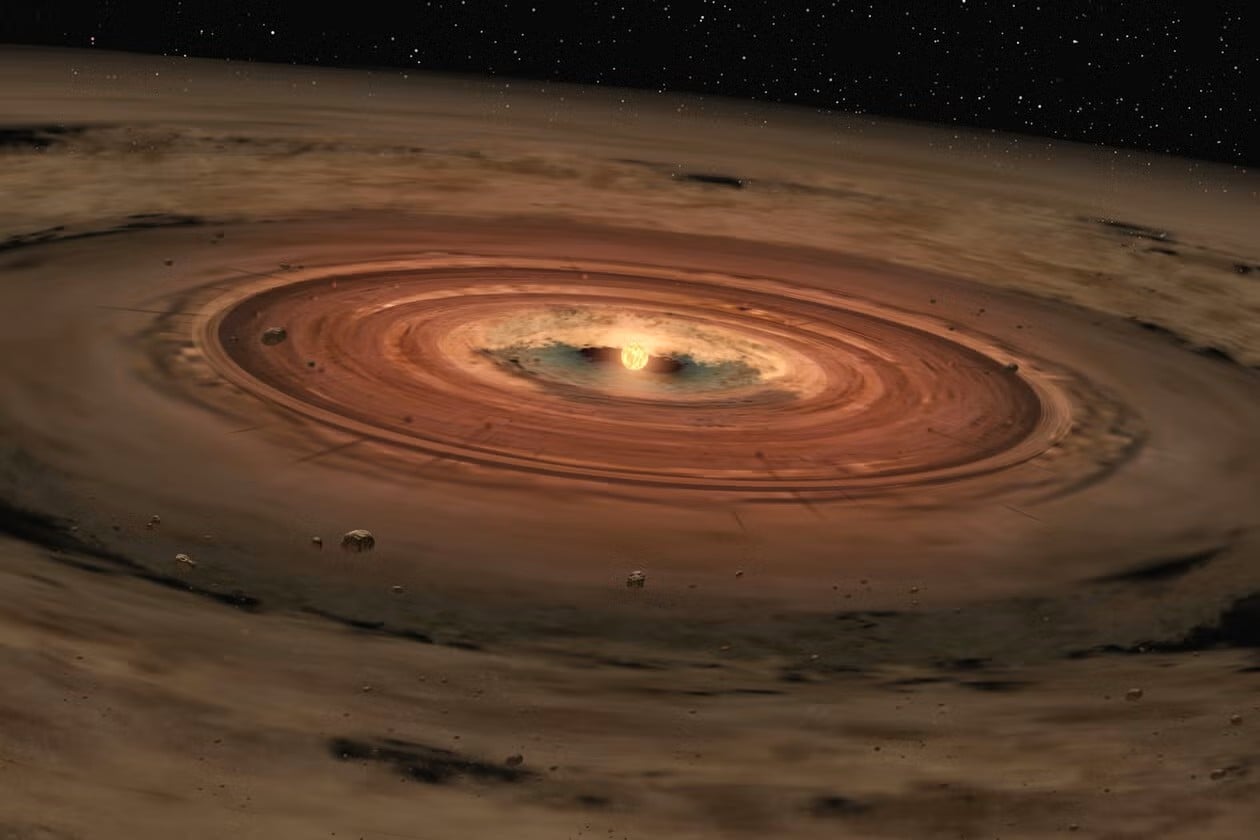
The early stages of the solar system remain shrouded in mystery. Not much remains from that time, but scientists have developed plenty of theories about what was going on back then. One of those theories attempts to answer a simple question – did the early system prefer “fire” or “ice”? A new paper published in Nature Astrophysics from lead author Damanveer Grewal, an assistant professor of Earth and planetary sciences at Yale, and his co-authors, have a definitive answer to that question – the early solar system preferred fire.
Obviously choosing between “fire” and “ice” is a massive oversimplification. What the paper actually looked at was a preference for what scientists called “condrules” (which were formed in “fire”) and “matrices” (which were formed in “ice”).
Chondrules are millimeter-sized pieces of solid rock that were created when clumps of dust in the vacuum of space were subjected to extreme heating events, such as massive shockwaves from supernovae. They then melted into liquid droplets and rapidly cooled to form what look like tiny pebbles – and lots of them.
Fraser talks about what was here before the solar system.
Matrices, on the other hand, were somehow not affected by the same shockwaves as the chondrule brethren. They are composed of “fluffy” dust grains, which include a lot of volatiles such as water ice. Why exactly they weren’t blasted by the same shockwaves that formed the chondrules remains somewhat of a mystery, but look at any meteorite from the early solar system and you’ll see the two types of material right alongside each other.
Scientists have known for awhile that in the relatively early stages of the solar system (i.e. 2 to 4 million years after it formed), the preference for fire (i.e. chondrules) was already noticeable. But Dr. Grewal and his team wanted to look even farther back – to the first million years or so of the solar system’s existence.
Unfortunately, there are no solid bodies from that age of the solar system still around in the same state today. That is thanks to a bunch of radioactive aluminum – Aluminum-26 to be precise. This material, which has a half life of only around 705,000 years, was likely seeded into the solar system by a nearby supernovae, and when it was aggregated into the early planetesimals that formed, it literally melted them from the inside with its radioactive heat, mixing up their internals to make the type of material they were made out of (either chondrule or matrix) indistinguishable from one another.
Fraser talks about the formation of the first terrestrial planets.
So Dr. Grewal and his team turned to other solutions. Iron meteorites from the early solar system, which might have been created by violent impacts on those early planetesimals, can be found on Earth. There are two tell-tale signs in those objects that hint at the original distribution of fire to ice – the sulfur content and the oxidation state of the iron.
Measuring those values, and using some models on how exactly they ended up that way, the researchers found that the iron meteorites had extremely low matrix levels – only 8%-17%. In other words, they did not have a lot of ice. Both values pointed towards the same preference for “fire”, showcasing that likely even in its earliest stages, the solar system had a preference for rock beads.
That makes sense when thinking about the physics of that early solar system. The giant protoplanetary disk that was forming around the Sun would act like a huge centrifuge. Centrifuges make materials of similar densities clump together, which is exactly what the chondrules did, allowing them to accumulate into the first planetesimals. Meanwhile, the matrices, being lighter and fluffier, were blown away, eventually coalescing into later-forming bodies such as comets.
Ultimately this paper represents one more step forward in our understanding of the early solar system, and it largely aligns with predictions most planetary scientists would have had. There are plenty of unanswered questions though – such as where precisely the AL-26 that caused the early planetesimals to melt came from, or why some material was flash heated into chondrules while others weren’t. But those will have to wait for further research or new data. Given how little has survived from those early stages of the solar system, researchers will have to come up with ever more inventive ideas to try to answer them.
Learn More:
Yale – From the start, the solar system chose fire over ice to build its first bodies
D. S. Grewal , Z. Zhanag, & J. Drążkowska – Planetesimal compositions governed by aerodynamic sorting from the onset of Solar System formation
UT – Jupiter Created the Birthplace of Rocky Bodies in the Early Solar System
UT – Ancient “Molten Rock Raindrops” Reveal When Jupiter Was Born