There’s a once-in-a-millennia astronomical opportunity coming up in about three years, and space agencies are rushing to make sure they’re ready for it. On Friday April 13th, 2029, the asteroid 99942 Apophis will fly within 32,000km of the Earth’s surface. The cruise liner sized piece of rock won’t hit us, but it should put on a great show, and, given the date it will pass by, is sure to cause panic amongst some parts of western civilization. One of the missions planned to watch this historic event (and hopefully alleviate some people’s fears) – ESA and JAXA’s Rapid Apophis Mission for Space Safety (Ramses) – has just passed a successful development milestone – turning on its computer for the first time.
That might seem like a relatively minor step in the life of a spacecraft. But it is a critical one. Ramses is on an extremely tight timeline. Original preliminary contracts for the mission were signed in October 2024, but the full construction contract was only signed on February 10th of this year. That means Ramses only has slightly more than three years to complete its full build, test, launch and mission. Compared to the decades-long procurement and build cycles of other space missions, that is blazingly fast.
To meet that deadline, the Ramses contractors are working in parallel. They broke the spacecraft into two parts – the “core” module with all of the brains and electronics, as well as its power distribution system, and the “propulsion” module, which includes the fuel lines, central structure, and actual propulsion mechanisms.
Video introducing the Ramses mission. Credit – ESA YouTube Channel
The propulsion module is being built in Lampoldshausen, Germany by ArianeGroup, one of Europe’s prime aerospace contractors. It features a type of carbon-fiber central mechanical structure that will hold all the other components in place. Critically, it will have all the necessary linkages to hook it up to the core module when its assembly is complete.
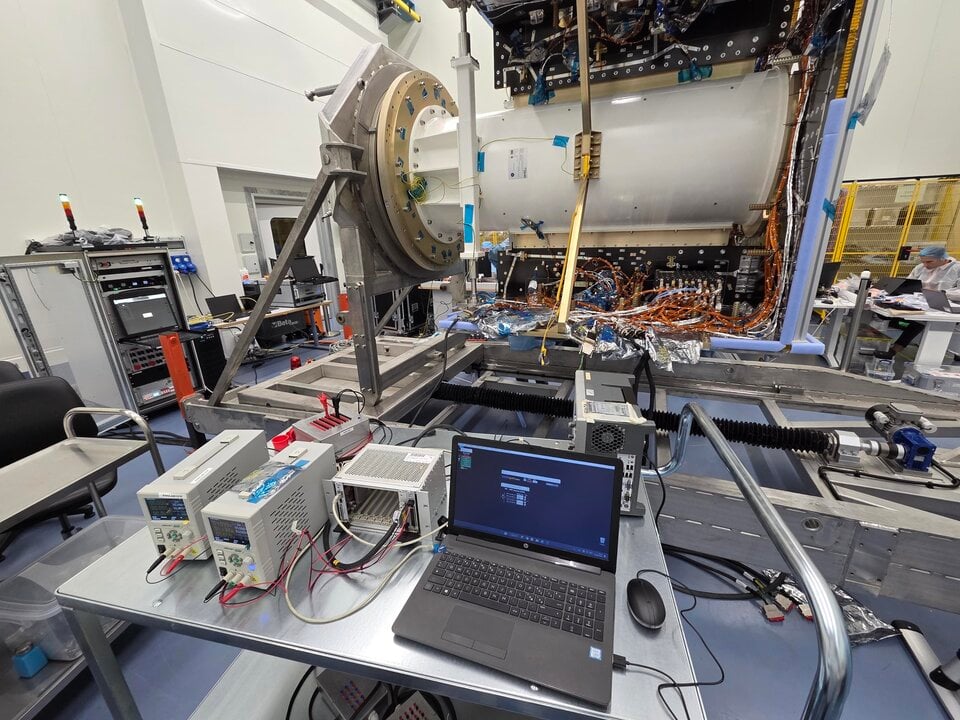
The core module itself is being assembled in Milan in a cleanroom run by OHB Italia. It contains the spacecraft’s “brains” and was one that was turned on for the first time recently. Many of its individual components, such as its Power and Conditioning Distribution Unit (PCDU), which ensures power is distributed to every component at the right voltage, and the Mass Memory Unit, which is essentially the spacecraft’s hard drive, had already been tested by themselves. But as any test engineer will tell you, hooking up multiple components that have been tested individually doesn’t always go well the first time.
Luckily, in this case, it did. The core module powered up without a problem, and all of the system components seemed to be operating as expected, at least according to a press release from ESA. That doesn’t mean the entire system is ready to go yet though. Both halves of the main spacecraft will be combined at ESA’s ESTEC Test Centre in the Netherlands next spring. And two CubeSats will also be taken along for the ride, one of which only had the contract signed to start its official build this July.
Video talking about the Ramses mission. Credit – VideoFromSpace YouTube Channel
Once the two halves are combined, Ramses will have to undergo a series of extreme tests, including a thermal vacuum test where it will be placed in a vacuum chamber and subjected to the extreme heat and cold of interplanetary travel. If it passes that battery of tests, it will be ready for its mission. If it doesn’t, engineers won’t really have a lot of time to fix whatever caused that failure.
The hard stop deadline for the mission is spring 2028, when Ramses will launch on a Japanese H-3 rocket in advance of the approaching asteroid. It will spend the rest of the time getting into position to observe as much as it can of this unique astronomical opportunity. And while Ramses still has a long way to go to get there, it doesn’t have a lot of time to do it. We’ll just have to see if the mission engineers can continue their rapid development pace for a year and a half longer.
Learn More:
ESA – First switch on for ESA-JAXA Ramses asteroid mission
UT – A Mission To Collect A Sample From Apophis
UT – ESA is Building a Mission to Visit Asteroid Apophis, Joining it for its 2029 Earth Flyby
UT – Asteroid Apophis’ 2029 Flyby Will Provide a Bonanza of Asteroid Science