
Lutetium clocks have achieved record accuracy and comparison precision, making them promising candidates for future time standards and measurements of gravity.
An atomic clock built from the element lutetium at the Centre for Quantum Technologies (CQT) at the National University of Singapore (NUS) has set a new benchmark for timekeeping accuracy. Results published in Nature on show that the clock measured its transition frequency to 19 decimal places, yielding an uncertainty of 1 × 10⁻¹⁹, the lowest reported for any optical atomic clock to date.
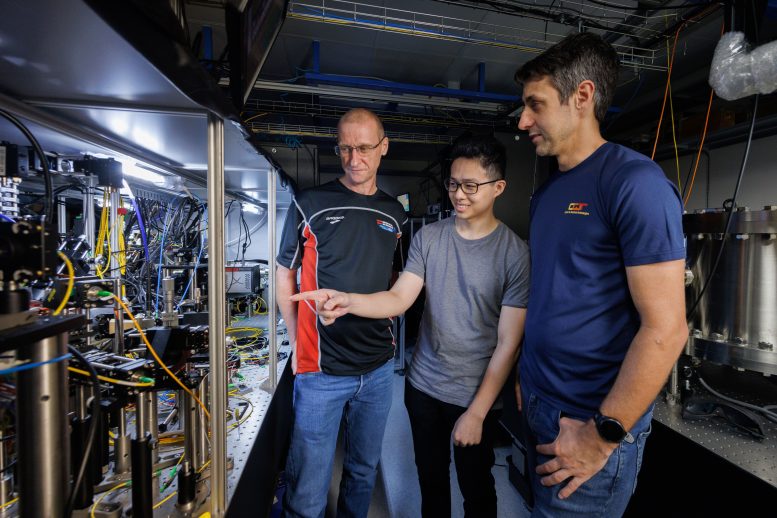
“I am confident that what we have now is the most accurate clock in the world,” says team leader Murray Barrett, a CQT Principal Investigator and Associate Professor in the Department of Physics at the National University of Singapore.
Lutetium’s resistance to temperature swings
Atomic clocks keep time by locking onto an atomic transition, an event that occurs when an atom’s electron swaps energy levels at a fixed frequency. A laser is tuned to match this “clock transition,” and the oscillations of its light mark time much as a pendulum’s swings do. In the CQT clock, that reference comes from a single electrically charged atom, or ion, of lutetium-176 (¹⁷⁶Lu⁺), whose transition is matched to a laser with a wavelength of 848 nanometers.
Temperature changes and magnetic fields can shift the transition frequency an atomic clock uses to measure time, so researchers must account for those influences when assessing its accuracy. Lutetium’s clock transition is barely affected by either, giving the clock a reference that remains stable across a wider range of conditions.
“The good properties mean that high accuracy can be achieved even in a wide range of environments,” Barrett says. “The lutetium clock would be stable even if you went from the hottest place recorded on Earth in Death Valley to the coldest place in the Antarctic plateau.”
The team began investigating lutetium more than a decade ago, suspecting that its properties could put it among the best elements for timekeeping. Turning that possibility into a working clock took years of precision engineering and measurements of the atom’s properties. The researchers also invented a method called “hyperfine averaging” to define the clock transition. To their knowledge, they remain the only group working with lutetium for timekeeping.
When millimeters change a clock’s ticking
The researchers built two lutetium clocks and compared their ticking over 200 hours using a technique called correlation spectroscopy. The clocks agreed within an uncertainty of 5.7 × 10⁻¹⁹, the most precise clock comparison ever reported. Taking more measurements could reduce that uncertainty further.
“There is a humorous saying that ‘A man with a watch knows what time it is. A man with two watches is never sure,” says Kyle Arnold, a senior research scientist at CQT at NUS and joint first author of the paper. “It basically tells you that the only way to test the accuracy of a standard is to compare clocks and demonstrate reproducibility.”
Gravity slows the passage of time, causing clocks at different heights to tick at slightly different rates. Optical atomic clocks operating at the 10⁻¹⁹ level can detect that effect over height differences of mere millimeters. The CQT comparison could resolve a difference of 5 millimeters, about 0.2 inches, between clocks on the same table. To keep that difference from limiting the comparison, the researchers independently measured the relative heights of the two lutetium ions to less than a millimeter.
That sensitivity to gravity also complicates checking the lutetium clock against the world’s other leading atomic clocks. Differences in gravity between locations on Earth are not yet known well enough to separate their effects from differences in the clocks’ performance at this level of accuracy.
“In the future, I just don’t see how this clock can be beat,” Barrett says.
Beyond the cesium second
Cesium atoms have provided the reference for defining the second since the 1960s, and cesium atomic clocks support GPS and synchronize communications and transportation networks. Optical clocks use much higher transition frequencies, giving them more oscillations to count over the same interval and helping them measure time more accurately. Recent record holders have used ytterbium, strontium, and aluminum, the elements whose performance the CQT team reports its lutetium clock has surpassed.
As these clocks improve, the international body responsible for time standards is considering their measurements for a redefinition of the second, expected in or after 2030. Their sensitivity to gravity could also become useful beyond the laboratory, allowing researchers to monitor gravitational changes across Earth. More accurate clocks could additionally help investigate unresolved questions in fundamental physics.
“The next step is to take the lab-scale clock and miniaturize it into a transportable system,” says Michael Lee, a PhD student on the NUS team and joint first author of the paper. Moving the clock out of the laboratory would enable new comparisons and allow researchers to explore those applications. The team expects it can make the clock smaller without compromising its accuracy.
Reference: “Lu+ optical frequency references with accuracy verified at the 19th digit” by K. J. Arnold, M. D. K. Lee, Qi Zhao, Qichen Qin, Zhao Zhang, N. Jayjong and M. D. Barrett, 23 September 2026, Nature.
DOI: 10.1038/s41586-026-11072-8
This project was supported by the National Research Foundation, Singapore, through the National Quantum Office, hosted in A*STAR, under its Quantum Engineering Programme 3.0 Funding Initiative (W25Q3D0007) and under its Centre for Quantum Technologies Funding Initiative (S24Q2d0009).
Never miss a breakthrough: Join the SciTechDaily newsletter.
Follow us on Google and Google News.