Can the words “integrity” and “media” even be mentioned in the same breath? ask whistleblowers Coleen Rowley and Tom Drake.
By Coleen Rowley and Thomas Drake
Special to Consortium News


In the formal rooms of the University Club of Chicago the loudest applause was not reserved for celebrity. It was reserved for refusal.
The refusal to accept an official story merely because it was official and trade editorial independence for access; refusal for leaving wrongdoing concealed because disclosure might end a career and invite prosecution or fracture and upend a life.
The second annual Integrity Media Independent Journalism Awards on Sept. 17 brought journalists, publishers, lawyers, supporters, and whistleblowers into the same room and treated their work not as separate pursuits, but as parts of a shared democratic undertaking against autocracy and authoritarianism.
We attended as members of the wider whistleblower community that the event sought to honor. What stayed with us was not simply the roster of accomplished recipients.
It was the recognition that journalism’s public value often begins well before publication with a person who decides that the public’s right to know outweighs the safety of silence, and continues through editors, publishers, lawyers, and readers willing to keep contested facts in public view.
In our mainstream media’s endless skewing and twisting of facts and news events on behalf of their powerful commercial funders and what some of us call the Powers-That-Shouldn’t-Be, the underlying principles of journalism integrity and freedom of the press are largely forgotten or simply ignored.
For instance, the following incredible distortion by the most mainstream of U.S. newspapers was recently noted by Roots Action.org:
“On Sunday, September 20, Trump threatened to blow up the entire nation of Iran. Obliterating a country of almost 90 million people and seriously risking escalation into a worldwide nuclear war would certainly be in contention for the worst (and last) crime in human history. [He repeated that genoicidal threat two days later from the podium of the U.N. General Assembly.]
On Monday, the International Day of Peace, the New York Times ran one article blaming Iran for the actions of the Houthis, and another fondly recalling how great the parties were at the Iranian embassy in Washington when Iran was ruled by a brutal dictator in the 1970s. On Tuesday, the Times published an article accusing the current president of Iran of being ‘combative’ by referring to the government bombing his country as an ‘enemy.’
But, as of Tuesday afternoon, searching for ‘Iran’ using the search engine on the New York Times website found no mention of the threat Trump made on Sunday.”
Establishment media’s continuing efforts to manufacture consent include important factual omissions; expert (even ‘poll-tested’) wordsmithing; creation of fact-free “narratives” propagating outright war propaganda (Kuwait’s newborns thrown out of incubators) and focus on Hollywood and other infotainment distractions to divide and conquer public opinion.
But mass media manipulation is backfiring according to last year’s Gallup poll showing U.S. trust in media sinking to a new low of 28 percent: lower even than Trump’s job approval. Anyone want to bet new polling will find the public’s repulsion and angst have only increased?
This leads one to ask: Can the words “integrity” and “media” even be mentioned in the same breath?
A Crisis of Trust
The Integrity Media gathering came at a moment of profound estrangement between Americans and the institutions that report the news.
The Gallup poll finding should not be used as a blunt weapon against every conventional newsroom, nor does the label “independent” confer automatic reliability.
Large organizations still produce indispensable reporting. Small outlets can also make mistakes, overstate evidence, or become captive to an audience. Distrust is not proof. It is a warning that journalism must earn credibility through transparent sourcing, documentary evidence, clear distinctions between reporting and opinion, visible corrections, and a willingness to test claims that flatter its own readership.
This is where the awards mattered. They did not ask the audience to replace one orthodoxy with another. At their best, they affirmed a method.
Follow evidence across ideological boundaries, make room for dissent, and scrutinize the exercise of power, whether governmental, corporate, military, technological, or cultural – without first asking whether the result will please a party, donor, platform, or professional circle.
The good news is that journalism integrity does still exist. And it’s being recognized. So, the authors found themselves extremely lucky when invited to attend the 2026 Integrity Media Independent Journalism Awards in Chicago as two of the dozens of several other whistleblowers indirectly honored.
Honoring Independent Paths
This year’s awards went to a stellar list of intrepid truth-seeking journalists (i.e. Judge Andrew Napolitano, the former New Jersey Superior Court judge, who delivered the evening keynote and received an Excellence in Journalism Award as host of his Judging Freedom program and all his interviews.
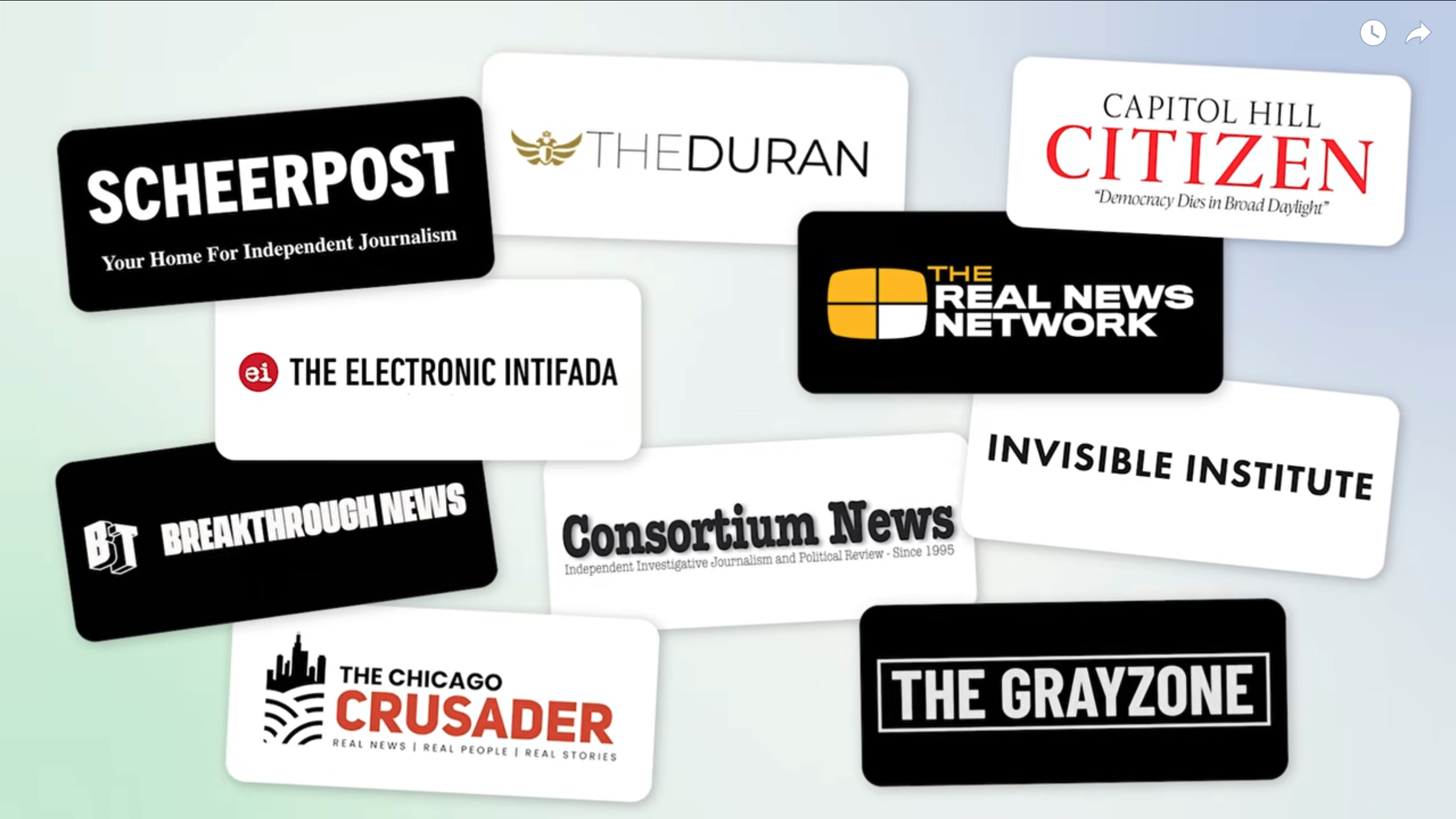
The other honorees were Max Blumenthal, the founder and editor of the Grayzone; Glenn Greenwald, System Update host; Chicago writer Jamie Kalven for the Invisible Institute; and Briahna Joy Gray as the Bad Faith host – all for constantly exhibiting the incredible bravery necessary to go against the manufactured narratives that have so reduced public trust in the mass media. Journalist Aaron Maté served as the master of ceremonies.
The recipients do not constitute a school of thought. Their subjects, styles, and political lineages differ, sometimes sharply. That is a strength rather than an embarrassment. A serious culture of free inquiry is not a club in which agreement is the price of admission.
Its test is whether people with divergent premises can produce evidence, expose themselves to challenge, and defend the public’s ability to hear arguments excluded from more cautious or consolidated institutions.
Each honoree also represented a distinct form of independence. The Invisible Institute’s work shows what patient, local accountability reporting can accomplish when its investigations of police misconduct combine public records, community knowledge, and sustained attention to people whom institutions often fail to hear.
Gray’s career illustrates the professional cost of resisting partisan discipline. The Grayzone has built an audience through detailed, factual reporting on war and foreign policy.
Greenwald’s work has repeatedly linked civil liberties to the protection of sources. Napolitano has used a high-frequency digital platform to place constitutional limits, war powers, surveillance, and personal liberty before a mass audience.
These are different models, but all depend on the freedom to pursue questions without a guaranteed or preferred answer.
The Sources Before the Story
The most consequential decision of the evening was to place whistleblowers at the center rather than at the margins.
The 2026 Courage in Journalism Award honored whistleblowers collectively as people who risk employment, reputation, liberty, and sometimes safety to disclose information the public otherwise might never see.
Greenwald accepted on their behalf after he moderated an afternoon discussion with civil liberties attorney Jenin Younes and former C.I.A. officer and whistleblower John Kiriakou, who blew the whistle on the agency’s torture program and was jailed for it.
In his acceptance remarks, Greenwald made the dependency plain. Much of the work for which journalists receive recognition would be “completely impossible” without sources willing to reveal illegality, abuse, or deception.
He distinguished the risks taken by visible journalists from the more extreme vulnerability of whistleblowers, who may lack comparable legal, cultural, and institutional protection.
His account of meeting Edward Snowden in Hong Kong returned again and again to the same moral question. What could compel a young person with a promising future to risk losing it?
The answer, as Greenwald recounted it, was that living silently with knowledge of concealed public harm could impose a cost of its own.
That relationship imposes obligations on journalists. Sources are not raw material. Newsrooms that solicit disclosures must be prepared to use secure communications, minimize identifying traces, explain risks without romanticizing them, verify independently, resist unnecessary exposure, and obtain specialized legal advice.
An award cannot provide those protections. It can, however, declare publicly that the source is part of the journalistic enterprise and not an inconvenient figure to be celebrated only after the danger has passed.
The remarkable panel discussion led by Greenwald also credited the whistleblowers which make his and other truthful news reporting possible.
The panel noted the dire need for legal protection of whistleblowers against the worst and most wrongheaded interpretations of the Espionage Act pushed through way back in 1917 by Woodrow Wilson to overcome public resentment when he betrayed his campaign promises by entering World War I.
The discussion confronted a structural imbalance. Institutions possess classification systems, investigative powers, public relations staffs, and years of public money with which to defend secrecy. A would-be source often has a conscience, a document, and very little time.
Digital surveillance has also made confidential communication more difficult, while the Espionage Act, written more than 100 years ago, lacks a general public interest defense for unauthorized disclosures and can expose national security sources to grave criminal jeopardy.
The result is a democratic paradox. The information most necessary for judging state power may be the information whose disclosure carries the greatest personal risk and cost.
Constitutional Memory
Napolitano’s keynote supplied the evening’s constitutional frame. Moving through the Alien and Sedition Acts, the National Security Act of 1947, and the USA PATRIOT Act, he argued that emergencies repeatedly become occasions for government to enlarge its authority and narrow individual liberty.
His central premise was that freedom of speech predates government; that even though the First Amendment did not actually create the freedom, it does act to restrain government from abridging it. Whatever one’s view of the Judge’s broader political conclusions, that distinction is essential to understanding why an independent press is not a favor extended by officials.
Judge Napolitano recounted the little-known true history about some of the Founding Fathers to explain his loyalty to the rule of constitutional law and why honest and truthful news reporting is now needed more than ever to restore that rule of law.
The First Amendment is also not a self-executing guarantee that difficult reporting will be financed, distributed, preserved, or even noticed. Legal protection against state censorship is foundational, but journalism requires an ecosystem around it with editors who will publish uncomfortable findings, technologists who can protect communications, lawyers who understand source risk, institutions prepared to withstand pressure, and audiences willing to support work before its conclusions are known.
Justice Louis Brandeis gave the classic democratic answer to falsehood in his 1927 concurrence in Whitney v. California. When time permits discussion and education, “the remedy to be applied is more speech, not enforced silence.” That principle does not absolve journalists of verification. It makes verification more urgent, because the purpose of more speech is not simply more noise. It is a public sphere capable of exposing error, comparing evidence, and correcting the abuse of power.
From Ceremony to Infrastructure
Awards are easy to dismiss as symbolic. Symbols, however, help determine who is seen, funded, defended, and remembered.
For independent journalists, public recognition can reduce isolation, widen an audience, introduce additional supporters ad advocates, and tell prospective sources that someone may be prepared to listen. For whistleblowers, it can challenge the familiar sequence in which official retaliation arrives immediately while public gratitude comes years later, if it comes at all.
The next task is to convert recognition into durable capacity. The community that gathered in Chicago can build shared legal referral networks, security training for reporters and sources, emergency support for people facing retaliation, transparent editorial and corrections standards, syndication partnerships that prevent important investigations from remaining inside small audiences and archives that keep censored, demonetized, or deplatformed work accessible.
It can also create fellowships and mentorship pathways for local reporters whose proximity to courts, police departments, schools, hospitals, and municipal agencies often give them the first view of systemic failure.
Such infrastructure should be deliberately plural. Independence is compromised when funding, friendship, or audience expectation becomes an unwritten veto. Credible outlets should disclose relevant conflicts, separate reporting from advocacy, link to primary material, when possible, invite substantive correction, and resist turning legitimate skepticism into reflexive disbelief.
The goal is not to make independent media respectable on establishment terms. It is to make it rigorous enough that inconvenient truths cannot be dismissed merely because of where they appeared.
Keeping the Light of Free Speech On
The lasting image of the Chicago event is a chain of courage. A source sees what an institution has hidden. A journalist verifies and contextualizes it. An editor accepts the risk of publication. A lawyer defends the right to report. A publisher keeps the work available. Readers decide that the information matters enough to sustain the people who brought it forward.
Break any link, and secrecy gains ground.
This is why the Integrity Media awards were more than a celebration of individual careers. They made visible a community whose members often work apart but whose functions are inseparable. They reminded journalists that sources can pay a far higher price than bylines reveal.
They reminded whistleblowers that they are not alone. And they reminded the rest of us that freedom of the press survives only when people practice it.
Consortium News founding editor Robert Parry’s standard remains demanding, precisely because it offers no comfortable destination. Have no preferred outcome. Follow the facts wherever they lead. The 2026 Integrity Media honorees demonstrate different ways of taking that journey.
The obligation now is to give more journalists and truth-tellers the tools, the protection, and the solidarity to begin it and the public a fair chance to hear what they find.
It is certainly hard these days to not fall into the overriding majority of saddened Americans who cannot help having lost their trust in the mass media’s current news reporting.
And the authors admit their own hope had begun to wane that we can ever recover from the onslaught and barrage of propaganda we are constantly fed, leaving us staring into the abyss of genocide and World War III.
But this year’s Integrity Media celebration of courageous independent journalism has quite lifted our hopes. If “courage is contagious” as Julian Assange once remarked, the honoring of integrity in media should itself serve to inspire and swell the ranks of those wishing to stand on the side of justice and on the right side of history.
“To me, the core responsibility of a journalist is to have an open mind toward information, to have no agenda, to have no preferred outcome. In other words, I don’t care what the truth is; I just care what the truth is. That’s the deal you make with your readers, to follow the facts wherever they lead.” –Robert Parry in “Parry’s Speech at I.F. Stone Award,” Consortium News, October 26, 2015.
“War is a racket. It always has been. It is possibly the oldest, easily the most profitable, surely the most vicious. It is the only one international in scope. It is the only one in which the profits are reckoned in dollars and the losses in lives.” – General Smedley D. Butler, (1881-1940)
“If there be time to expose through discussion the falsehood and fallacies, to avert the evil by the processes of education, the remedy to be applied is more speech, not enforced silence.” –Justice Louis Brandeis, 1927
“If you’re not careful, the newspapers will have you hating the people who are being oppressed, and loving the people who are doing the oppressing.” –Malcolm X
“If we are not able to ask skeptical questions, to interrogate those who tell us that something is true, to be skeptical of those in authority, then, we are up for grabs for the next charlatan (political or religious) who comes rambling along.” –Carl Sagan
“If you’re taking flak, you’re over the target.” –WWII Army Air Force phrase
Coleen Rowley is a retired F.B.I. Special Agent and former Minneapolis Division Legal Counsel and was one of 2002 Time Persons of the Year for her whistleblowing to the Joint Intelligence Committee Inquiry and other congressional committees about some of the F.B.I.’s failures in not having prevented the 9-11 attacks; a long-time member of Minnesota’s Women Against Military Madness (44 year old) non-profit; as well as an expert with the Eisenhower Media Network.
Thomas A. Drake is a decorated U.S. Air Force and Navy veteran, a former C.I.A. analyst, and a former senior executive at the National Security Agency. He became a whistleblower after raising urgent concerns through official channels about 9/11 intelligence ailures, the post 9/11 intelligence cover up, mass domestic surveillance, constitutional violations, and billions in fraud, waste, abuse and mismanagement within the N.S.A. before making unclassified disclosures to the press in the public interest. He also served as a key material witness for two congressional 9/11 investigations including the Joint Inquiry and a DoD Inspector General audit and investigation at N.S.A. Prosecuted under the Espionage Act and facing 35 years in prison, Drake ultimately prevailed after all ten felony charges were dismissed and went free in a plea deal on his terms. He received the 2011 Ridenhour Prize for Truth-Telling and remains an advocate for whistleblowers, moral agency, privacy, human rights, accountable government, First Amendment freedoms and as an eyewitness for history to the abuse and misuse of power holding up a mirror to pathocracy, as well as the banality of evil.