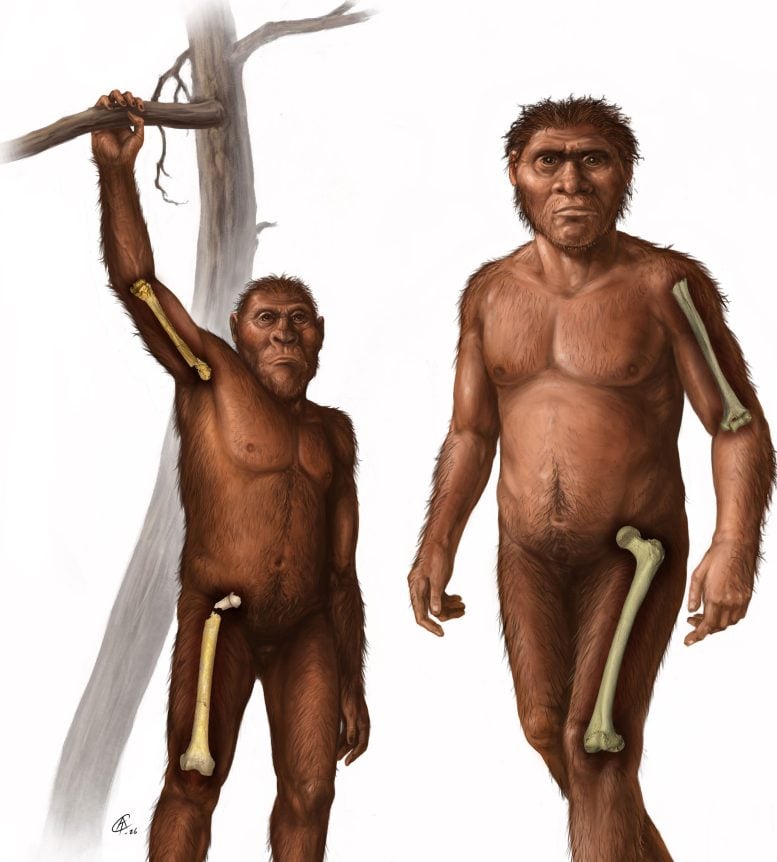
By comparing the strength of fossilized limb bones, a research team led by the Keck School of Medicine of USC found new evidence about how early human ancestors moved.
For Australopithecus, an early human ancestor that lived roughly 2 million to 4 million years ago, walking upright did not necessarily mean leaving the trees behind. A new analysis of fossilized limb bones suggests these ancestors combined substantial time in trees with a way of using their legs that resembled our own.
The findings help address a question about bipedalism, or walking on two legs, a defining feature of humans compared with other apes. When did our ancestors shift from moving both through trees and across the ground to living almost entirely on the ground?
An international team led by the Keck School of Medicine of USC investigated that transition using fossils from seven individuals belonging to Australopithecus and its descendants, early Homo. The fossils ranged from about 1.5 million to 3.7 million years old. Published in Science Advances, the study points to a major change in movement around the transition between these two groups.
Bones preserve evidence of everyday movement
Bones can reveal something about an individual’s life because they adapt to the forces placed on them. Animals that regularly move through trees tend to have relatively strong arm bones, while humans who walk upright on the ground tend to have stronger thigh bones. Comparing those strengths offers evidence of how an individual used its limbs, complementing studies of skeletal features that evolved over many generations.
To examine that evidence, the researchers used computed tomography, or CT, scans. These scans use X-rays to produce detailed images of bones and their internal structure. The team measured the thickness and structure of the bone shafts, estimated their resistance to bending and twisting, and compared the upper arm, thigh, and shin bones within each individual.
The early Homo individuals, which lived about 1.8 million to 2.3 million years ago, showed a pattern resembling modern humans. Their thigh bones were relatively strong compared with their arm bones, suggesting a greater reliance on walking on the ground. The results support the idea that a substantial behavioral shift had occurred by roughly 2 million years ago.
“We’re proposing that relative limb strength is a ‘threshold trait’—a difference that marks an important and fundamental shift in behavior between Australopithecus and Homo,” said Kristian J. Carlson, PhD, the study’s lead author and a professor of clinical medical education at the Keck School of Medicine.
Australopithecus combined walking with tree travel
The Australopithecus bones showed a different combination. Their arms were strong relative to their thighs, much like those of modern apes. Within the legs, however, the relationship between thigh and shin strength followed a more human-like pattern. Together, those comparisons suggest that the upper limbs remained important for moving through trees while the lower limbs supported upright walking.
“Australopithecus combined an ape-like upper limb strength with a human-like pattern in the legs, suggesting they had a unique movement strategy that has no modern comparison,” Carlson said.
That combination bears directly on a longstanding disagreement about how much time Australopithecus spent in each environment. Some researchers have argued that these ancestors mostly walked upright on the ground. According to Carlson, the new evidence instead suggests that movement in trees remained a substantial part of their lives.
Did walking farther help brains grow?
The shift in limb use also roughly coincides with the beginning of a dramatic increase in brain size. Scientists have proposed explanations for that growth involving language, tool use, and changes in how human ancestors found food. Carlson and his colleagues suggest that walking greater distances on the ground may help connect the changes in limb strength and brain size.
“We speculate that the shift toward more walking may have placed new demands on the body and brain, which could help explain why these changes happened around the same time,” Carlson said.
Reference: “Proportional limb strengths signal an adaptive shift in arboreality in early human evolution” by Kristian J. Carlson, Christopher B. Ruff, M. Loring Burgess, Adam D. Sylvester, Tea Jashashvili, Jason L. Heaton, Travis R. Pickering, Lauren Sarringhaus, Timothy M. Ryan, Amélie Beaudet, Robin H. Crompton, A. J. Heile, Dominic Stratford, Kathleen Kuman, David Lordkipanidze and Ronald J. Clarke, 16 September 2026, Science Advances.
DOI: 10.1126/sciadv.aeh1752
This work was supported by Standard Bank and JP Morgan Chase; the Palaeontological Scientific Trust; the National Research Foundation (South Africa) African Origins Platform, Strategic Research Infrastructure Grant [#75430] and Centre of Excellence in Paleosciences; the National Science Foundation [BCS-2609570, SBR-8919155, SBR-8919749, BCS-1316104 and BCS-1419564]; the Wenner-Gren Foundation for Anthropological Research; the L.S.B. Leakey Foundation; and the Keck School of Medicine of USC.
Never miss a breakthrough: Join the SciTechDaily newsletter.
Follow us on Google and Google News.