
Most AI agents today are stateless, even when they sound conversational.
You explain your background, clarify what you’re trying to accomplish, and correct the agent two or three times. Then the session ends, and all of that context disappears. The next conversation starts from scratch, as if the previous one never happened. That’s a big reason AI still feels like a disposable tool instead of a partner that understands you over time.
What’s missing is memory.
A useful AI agent should be able to remember past interactions, learn a user’s preferences, and adapt as their goals change. It also needs to know what’s worth keeping and what should be forgotten. The encouraging part is that building this kind of memory no longer requires a research lab. A small set of architectural patterns now works across foundation models and agent frameworks.
In this post, I’ll explain why memory leads to better AI interactions, how production memory systems are designed, and which decisions determine whether an agent feels genuinely persistent and personal or simply stores everything it sees. I’m writing from the perspective of an engineer who builds large-scale distributed systems and has seen firsthand how quickly context-free agents frustrate users.
What Is an Agent Memory Layer?
An agent memory layer gives agents a way to store, retrieve, and use context across interactions, so every session doesn’t begin from scratch.
A well-designed memory system usually includes four capabilities: short-term memory for recent conversation history; long-term memory for knowledge about the user, task, and domain; embeddings for semantic retrieval, which can find relevant information without relying on exact keywords; and access policies that keep stored information secure and its use predictable.
Memory is most useful when it operates as a standalone service instead of being tied to a specific model, cloud provider, or agent framework. The agent reads from and writes to an external, controlled context store, while the memory system remains independent of where inference happens. That same layer might support a customer-service agent today and a coding assistant tomorrow.
This separation also lets teams introduce memory gradually. They can begin by adding it to an existing agent, then expand it into a shared foundation as their agent platform grows.
The Architecture: Events, Strategies, and Memory Records
Production memory systems often follow the same basic flow, even when they use different terminology: capture what happened, decide what is worth remembering, and store the result for later use. One useful way to describe this architecture is through three concepts: events, strategies, and memory records.
You can see variations of this pattern in systems such as Mem0, LangMem, and Zep’s temporal knowledge graph. Earlier work such as the 2023 MemGPT paper also helped establish the idea of managing memory beyond a model’s immediate context window. The implementations differ, but the underlying ideas carry across stacks.
The memory store holds the information an agent retains. Events are the raw inputs flowing into the system: messages, corrections, decisions, and other interactions, along with metadata such as timestamps, actor IDs, and session context. Strategies determine how those events are processed and which details deserve to be kept. The result is a set of memory records containing the facts, preferences, and goals the agent can retrieve later.
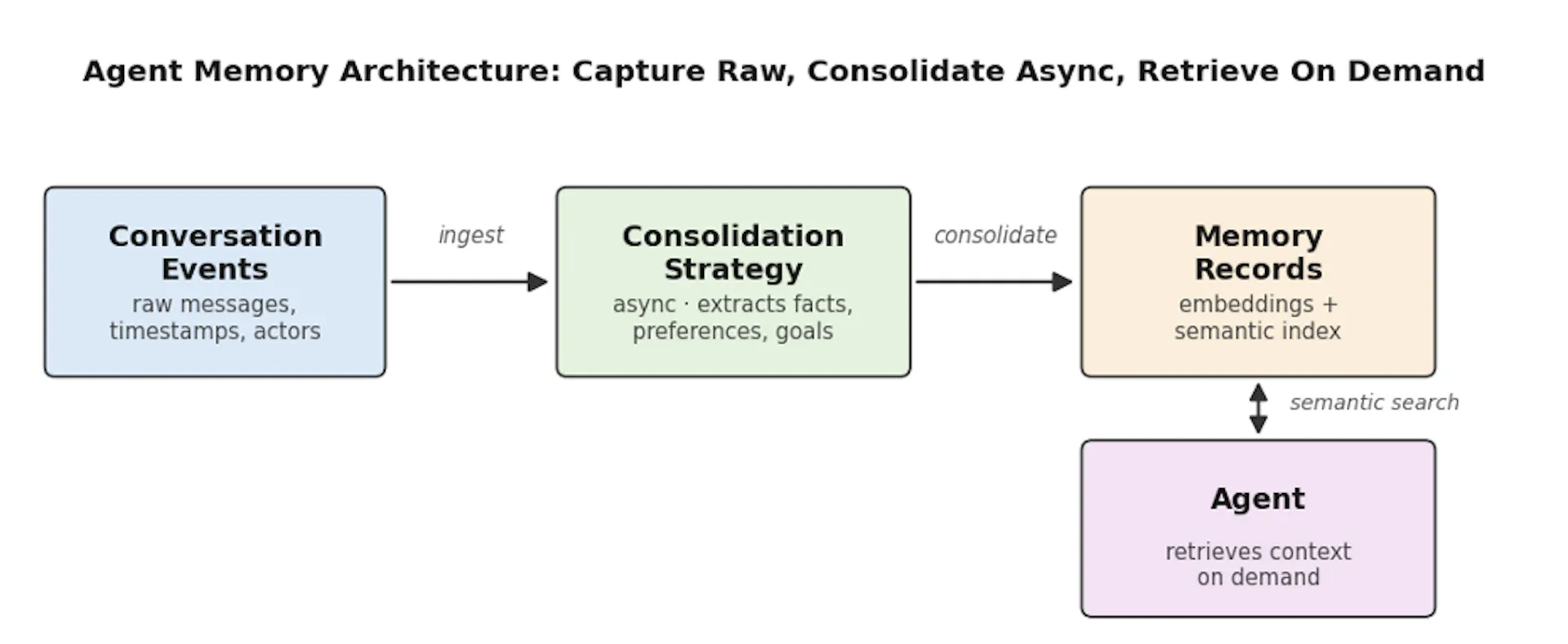
The implementation pattern is clean. You initialize a memory client, then interact through three primary operations: storing events as they happen, retrieving memories via semantic search, and managing lifecycle (cleanup, expiry, and privacy requirements). In pseudocode:
# 1. Store a raw conversational event as it happens
memory.record_event(
	session_id = session,
	actor      = "user",
	content    = user_message,
	timestamp  = now()
)

# 2. Asynchronously, a strategy consolidates events into
#	memory records: facts, preferences, goals worth keeping

# 3. Retrieve relevant memories via semantic search
relevant = memory.search(
	query = "user's programming language preference",
	top_k = 5
)

# 4. Manage lifecycle: expiry, cleanup, right-to-be-forgotten
memory.delete_records(filter = older_than(days=90))
The important design choice is to keep each stage separate. Events record interactions as they happen. An asynchronous consolidation process, often powered by an LLM, reviews those events and decides what belongs in long-term memory. When the agent needs context later, it searches the consolidated memories by meaning instead of scanning entire conversation logs.
Retrieve On-Demand, Don’t Load Everything Upfront
This design gives an agent personalized context without stuffing every memory into the prompt. Context windows are limited, and most stored information won’t matter for the current task. Instead of loading everything upfront, the agent retrieves only what it needs.
If a user asks for code, the agent can check for a saved programming-language preference before asking which language to use. If the user wants a restaurant recommendation, it can first look for dietary needs or favorite cuisines. Over time, the memory system becomes more useful while the agent’s working context stays focused.
Knowing What to Forget Is a Feature
A memory system that keeps everything is little more than a log, and logs don’t know when information has stopped being true. An old preference can lead to confidently wrong personalization: “You told me in January that you use Java.” Keeping information indiscriminately also creates unnecessary privacy risk.
A good memory layer is designed to forget. Temporary context should expire, newer facts should replace the ones they supersede, and users should have a clear way to delete stored information. That includes supporting applicable legal obligations such as the GDPR’s right to erasure. If you can’t explain how a fact leaves the system, the design isn’t finished.
The Takeaway
Memory is what turns a capable one-off interaction into continuity over time. The architecture is fairly simple: capture interactions as events, process them asynchronously into useful memory records, retrieve the relevant ones when needed, and deliberately remove information that is outdated or no longer required.
You can build this layer yourself or use one of the growing number of open-source and managed services. Either way, the underlying pattern remains much the same. The best agents won’t be judged only by how well they answer the current question, but by how effectively they carry forward what mattered from the last hundred interactions.