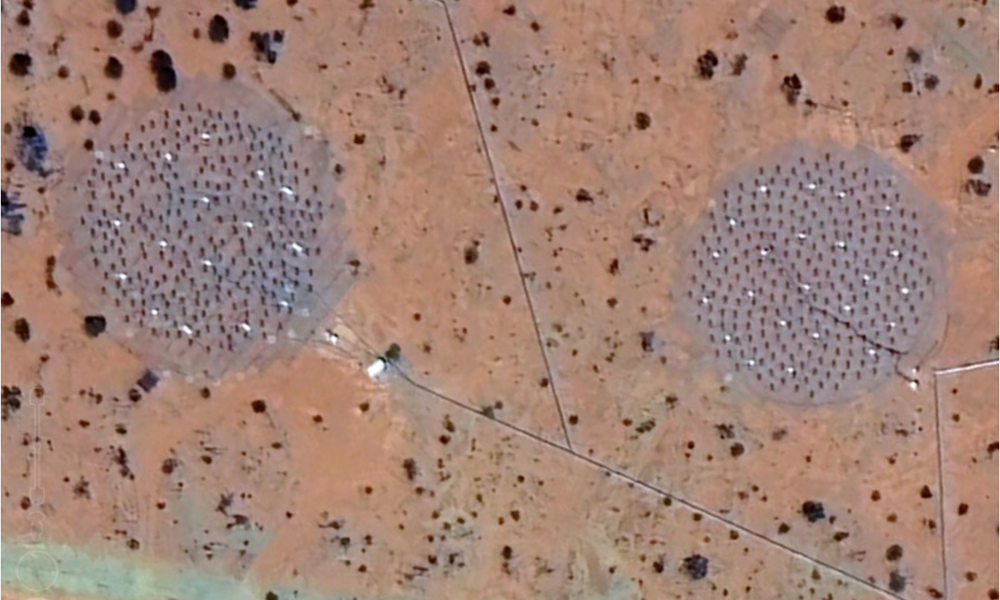
Scientists love taking inspiration from nature. The evolutionary processes that have created such a diverse panoply of life on Earth can be a great source of ideas in solving technical problems. One such example is the pattern of sunflower seeds – they are arranged in a mathematically optimized pattern known as a Vogel spiral, and the international team building the Square Kilometer Array (SKA) in Australia decided to lay out their antennas in a similar pattern. But, as they report in a paper recently published in the Journal of Astronomical Telescopes, Instruments, and Systems, when they did so they found a huge blind spot in the data which hints that maybe this particular natural pattern might need to be modified to work well for this particular application.
To understand how this happened, first let’s look at what the team was actually doing, since they haven’t started to build the full telescope yet. The branch of SKA in Australia is designed to look at “low” radio frequencies between 50 and 350 MHz and is known as SKA-Low. When the full SKA is completed, it will be combined with a branch in South Africa that will use larger dishes to monitor higher wavelengths.
SKA-Low, on the other hand, will use a massive number of a type of antenna called a phased aperture array, which won’t move at all, but which will use their configuration compared to one another and a technique known as beamforming to “point” at different parts of the sky. Each individual antenna, known as a SKALA4.1, will look like a “Christmas tree” antenna that populated so many houses decades ago.
Video discussing the SKA’s construction process. Credit – SKA Observatory YouTube Channel
One important feature of SKA-Low is its scale, though. It will have 512 circular stations, each packed with 256 SKALA4.1s, spread out over 75 square kilometers of Australian outback. That’s over 131,000 individual antennas to make up this part of the system. So it only makes sense they would want to test them beforehand.
In fact, they’ve done so three times now, using specially designed testbeds at Inyarrimanha Ilgari Bundara, CSIRO Murchison Radio-Astronomy Observatory. Their second prototype, Aperture Array Verification System 2 (AAVS2) used a pseudo-random layout to distribute its 256 antennas. That randomness was intentional, though. If the antennas were arranged in neat, rigid rows they create data artifacts known as “grating lobes” which can completely mess up the data the antennas collect.
Unfortunately, that same randomness caused a different problem. By pure chance, several antennas were placed too close to one another. Since the antennas themselves also scatter electromagnetic energy, if another antenna is too close, it could pick up that scattered energy and think that data is legitimate. This is exactly what the engineers saw happening with AAVS2. At lower frequencies – especially 55MHz and 78MHz – the antennas that were slightly too close together resonated with one another, causing problems with the data.
Video detailing the features of the SKA. Credit – Australian Academy of Science YouTube Channel
So, they moved on to a different strategy with AAVS3, their next planned test that took place in 2023. In this case, they laid out the antennas in the Vogel spiral that works so well for sunflowers. At least in theory, this layout provides the best of both worlds. All the antennas are evenly spread out, ensuring no two are too tightly clumped together, but also aren’t in the types of linear pattern that causes the data artifacts.
While they were building the test setup, though, simulations started to show a potential weak point. They predicted a significant drop-off in sensitivity at 125 MHz if the telescope was pointed straight up – right where the Milky Way occasionally passes. With that potential limitation in mind, the engineers set about testing the antenna configuration.
They found the exact problem the simulations were predicting. There was a significant drop-off in sensitivity right at 125MHz, again caused by the antenna configuration itself rather than any software or hardware problem. A Vogel spiral does a great job of making sure no two antennas are huddled too closely together. But it also naturally repeats the same spacing over and over again.
Another video detailing the SKA, and hwat it will be capable of when it comes online next year. Credit – IFLScience YouTube Channel
When researchers analyzed the inter-antenna distances of the AAVS3 test setup, one particular distance came up over and over again – 2.4m. That distance corresponds exactly to the wavelength of a 125MHz radio wave signal. When a signal at that frequency comes in from directly overhead, the antennas begin to interact, creating destructive interference and cancelling out each other signals.
Those kinds of experimental findings are exactly why it’s important to run preliminary tests before committing to placing 131,000 individual antennas. Having a “gap” in SKA-Low’s sensing capabilities is unacceptable, so the researchers have to come up with an alternative configuration. Their solution, known as a Perturbed Vogel pattern, uses the same basic sunflower-like spirals, but introduces a small “perturbation” to each antenna’s position. This ensures two antennas are never too close together, but also not spaced evenly apart either.
As SKA-Low continues its path towards deployment, there will undoubtedly be other technical challenges it has to overcome. At least this one was easy enough to understand and to fix. Not everything in radio astronomy is that easy, but that’s also part of what makes the field so exciting. And, when it comes online, the SKA is going to be one of its most important instruments for some time to come.
Learn More:
SPIE – Testing an antenna layout for the SKA-Low telescope
S. Asayama et al – On-sky verification of the Vogel layout with the SKA-low prototype station Aperture Array Verification System 3
UT – The Square Kilometre Array Will Revolutionize the Hunt for Alien Life
UT – The Square Kilometre Array Releases its First Test Image