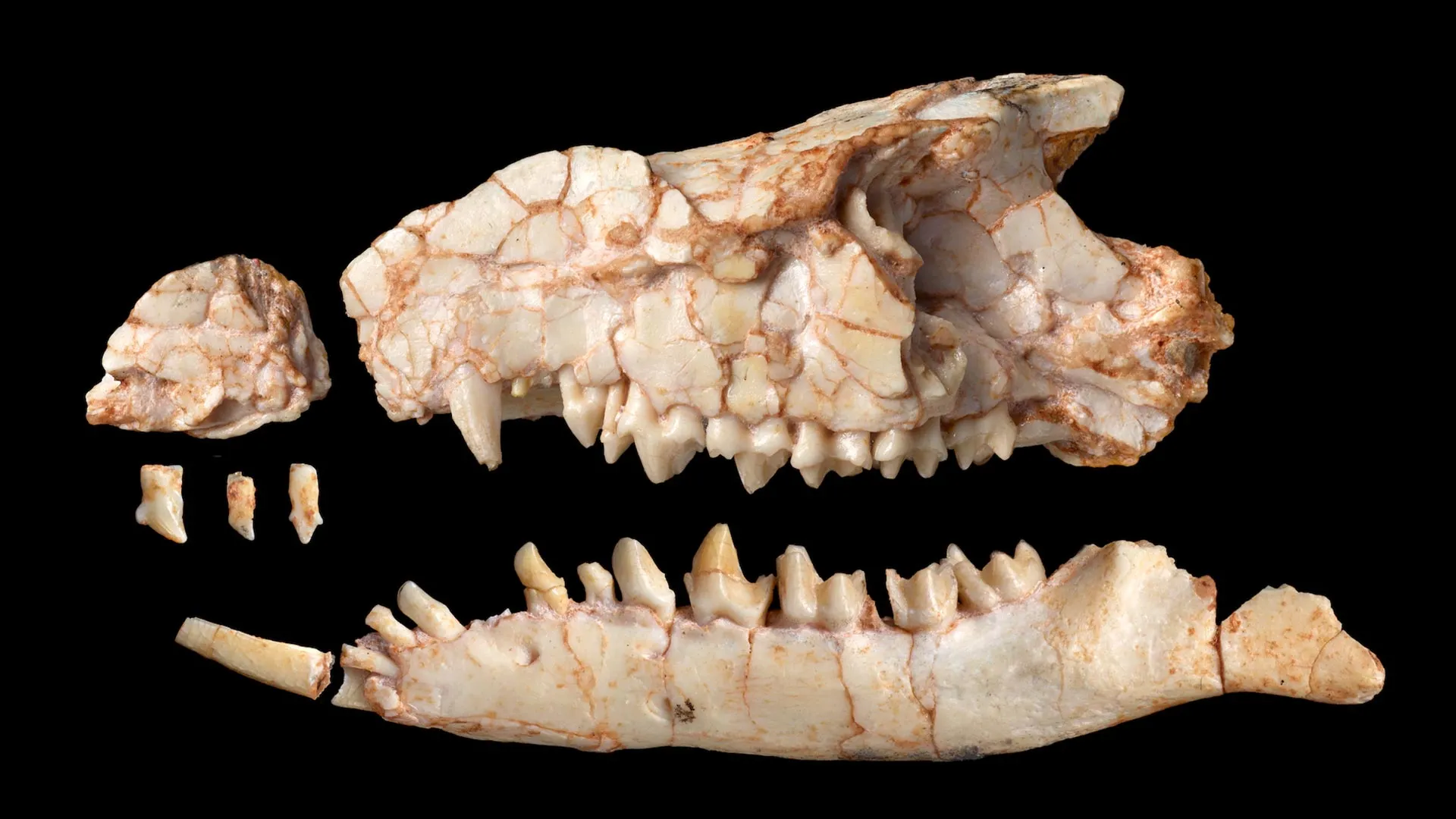
A remarkably complete fossil discovered in Mongolia’s Gobi Desert is changing how scientists view mammal evolution during the age of dinosaurs. The newly identified species, described in the journal Nature by researchers from the American Museum of Natural History, Stony Brook University, University of Arizona, and Arcadia University, provides new evidence about an extinct group of mammals called zhelestids.
For decades, many scientists thought zhelestids were closely related to modern placental mammals. The new fossil suggests otherwise. Instead, zhelestids appear to have belonged to a very different branch of early mammals, overturning an interpretation that was based largely on fossil teeth.
“This discovery illustrates why fieldwork remains indispensable to understanding life’s history,” said the study’s lead author Andres Giallombardo, who found the specimen as a graduate student on a Museum-sponsored expedition in 2004. “It was the thrill of a career to find a new species so completely preserved that also solves a longstanding scientific problem, and a reminder that the Gobi Desert, which is well known for fossils, continues to change science.”
Fossil Teeth Pointed Scientists in the Wrong Direction
Zhelestids have been known to paleontologists for nearly 40 years, but most discoveries consisted of isolated teeth or incomplete remains. Their teeth were unusually specialized for eating plants compared with the sharper teeth used for eating insects that are common among many Cretaceous mammals.
Those features led some paleontologists to propose that zhelestids represented an unknown group of hoofed mammals. Scientists also debated whether they might have been placental mammals living during the Cretaceous, part of the broad group that today includes humans and most living mammal species, or whether they were part of a separate lineage that independently evolved similar characteristics.
Molecular clock studies have supported the possibility that placental mammals originated well before the end of the Cretaceous. The newly described fossil, however, provides physical evidence pointing in another direction.
“Molecular models based on living animals can predict the past, but fossils provide the evidence needed to test those predictions,” said study coauthor Paul Velazco, a comparative biologist at Arcadia University.
A Nearly Complete Skeleton Reveals the Animal’s True Identity
The new species, Tamirkhan balcarceli, was discovered in the eastern Gobi Desert and is the most complete zhelestid specimen found so far. Because so much of the animal is preserved, scientists can now see what members of this mysterious group actually looked like.
Tamirkhan has the low, rounded teeth associated with zhelestids. But it also possesses long, continuously growing incisors and several distinctive skull features seen in zalambdalestoids, a group of small, shrew-like insectivore mammals.
Its limbs provide another important clue.
“Tamirkhan‘s hind legs are long and slender with distinctive ankles, traits that are unmistakably zalambdalestoid,” said study author Shawn Zack, a paleontologist at the University of Arizona.
Taken together, those features led the researchers to conclude that zhelestids were neither placental mammals nor especially similar to placentals. Instead, they were part of the zalambdalestoid group.
The finding also suggests that Cretaceous mammals may not have been as anatomically varied as scientists might have inferred from their teeth alone. The rounded teeth associated with zhelestids, which resemble those found in many plant-eating mammals, were probably an example of convergent evolution. This occurs when unrelated animals independently develop similar traits as they adapt to comparable ways of life.
Why Teeth Cannot Always Reveal the Whole Animal
The discovery highlights the risks of reconstructing an extinct animal from only a small part of its skeleton.
“More than 200 years ago, French naturalist Georges Cuvier famously argued that a single tooth could allow scientists to predict the anatomy of an entire animal,” said study coauthor Maureen O’Leary, a paleontologist at Stony Brook University and research associate at the Museum. “While teeth remain among the most informative fossils available, this work demonstrates that teeth cannot always tell us how the whole animal looked.”
Measuring between 6-7 inches from head to tail, Tamirkhan had unusually elongated hind limbs that gave it an appearance somewhat like a rabbit. Paleontologists have sometimes informally called zhelestids “Cretaceous rabbits” because they resembled rabbits despite being only distantly related to modern ones.
The Gobi Desert Continues To Reshape Mammal Evolution
The specimen also demonstrates the exceptional scientific value of the Gobi Desert. Along with fossil sites in Kazakhstan, Kyrgyzstan, and Uzbekistan, the region is one of the few places where zhelestids have been preserved.
“The Gobi is one of the only places where we routinely recover such remarkably complete Cretaceous mammals,” said coauthor Michael Novacek, a curator in the Museum’s Division of Paleontology who has co-led annual expeditions to the Gobi since 1990 in partnership with the Mongolian Academy of Sciences. “These extraordinary fossils continue to transform our understanding of mammalian evolution.”
The researchers were also able to place the new species within the mammal family tree using MorphoBank, a comprehensive research platform for studying mammalian evolutionary relationships. First published in 2013, the database has grown for more than a decade as scientists have added an increasing number of important fossil species. It now provides the most comprehensive framework yet assembled for analyzing relationships among early mammals.
Other authors on this study include Eva Hoffman from Yale University.
Fieldwork and laboratory research in the Gobi Desert were supported in part by the Margaret and Will Hearst Paleontological Research Fund and the Frick Laboratory Endowment at the Museum. The research also received support from the U.S. National Science Foundation, grant numbers MRI-R2 0959384, EAR 2506729, and EAR 2506727.