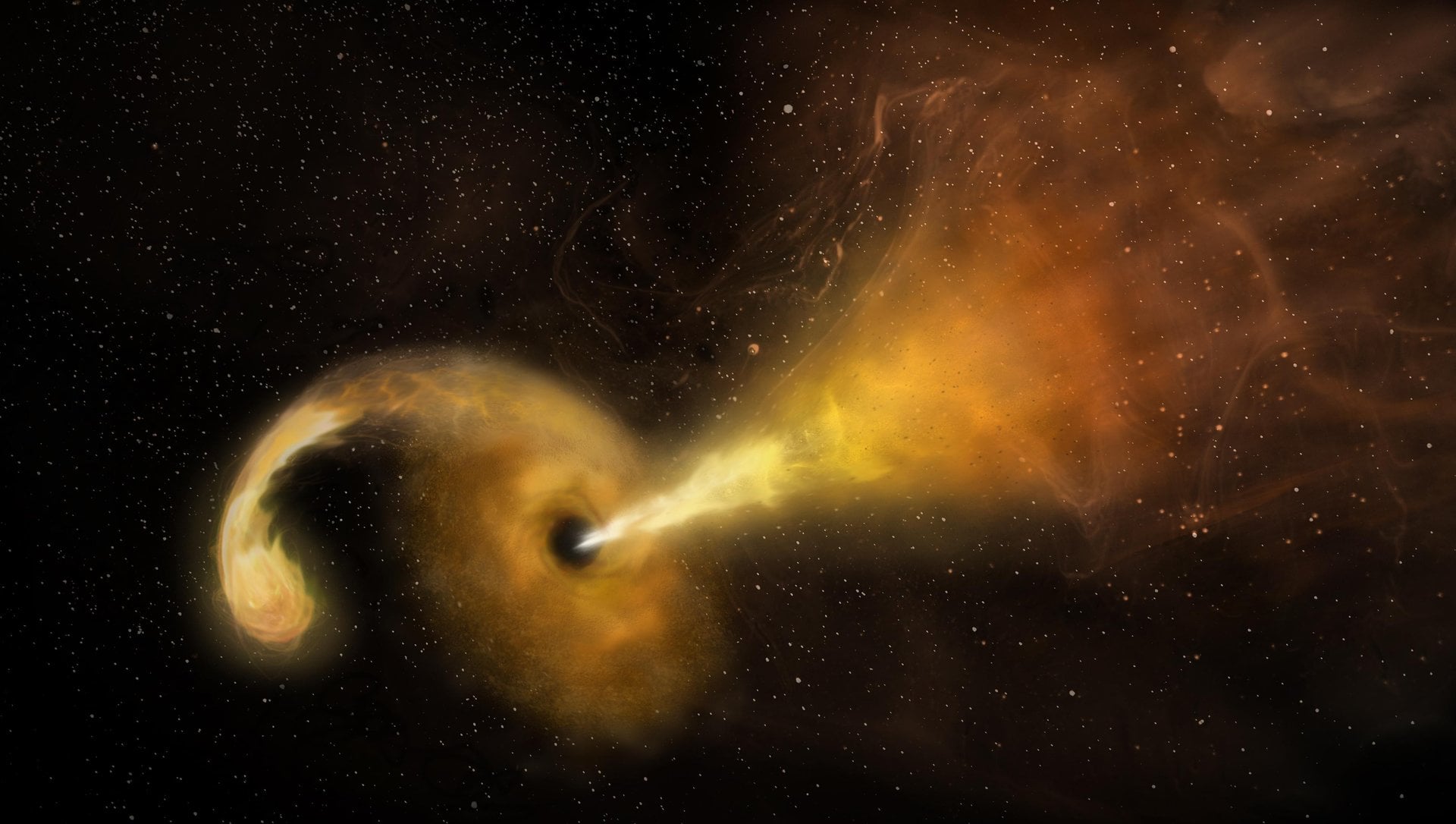
The easiest way to find a black hole is to look for its jets. These trails of ionized gas stream away from a black hole at near light speed. They form when a black hole consumes matter and forms an accretion disk of hot plasma. Inactive black holes don’t produce jets, making them harder to discover. But just how active does a black hole need to be for jets to form? This is the focus of a new study in Nature Astrophysics.
Stellar-mass black holes are usually active because of a companion star. If a black hole closely orbits a stellar companion, it can strip the outer layers of the star and consume the material. The more material a black hole can capture, the faster it can consume matter and the more active it is. At least up to a point.
The faster a black hole consumes matter, the more heat and light it produces. If a black hole consumes matter too quickly, this thermal pressure will push away infalling gas. Clearing the table, you might say, and making the black hole inactive. This maximum rate of consumption is known as the Eddington Limit. Fortunately, a stellar-mass black hole doesn’t need to eat at nearly that limit to create jets. Based on observations, the critical rate is only about 2% of the Eddington Limit. This is why so many stellar-mass black holes have jets.
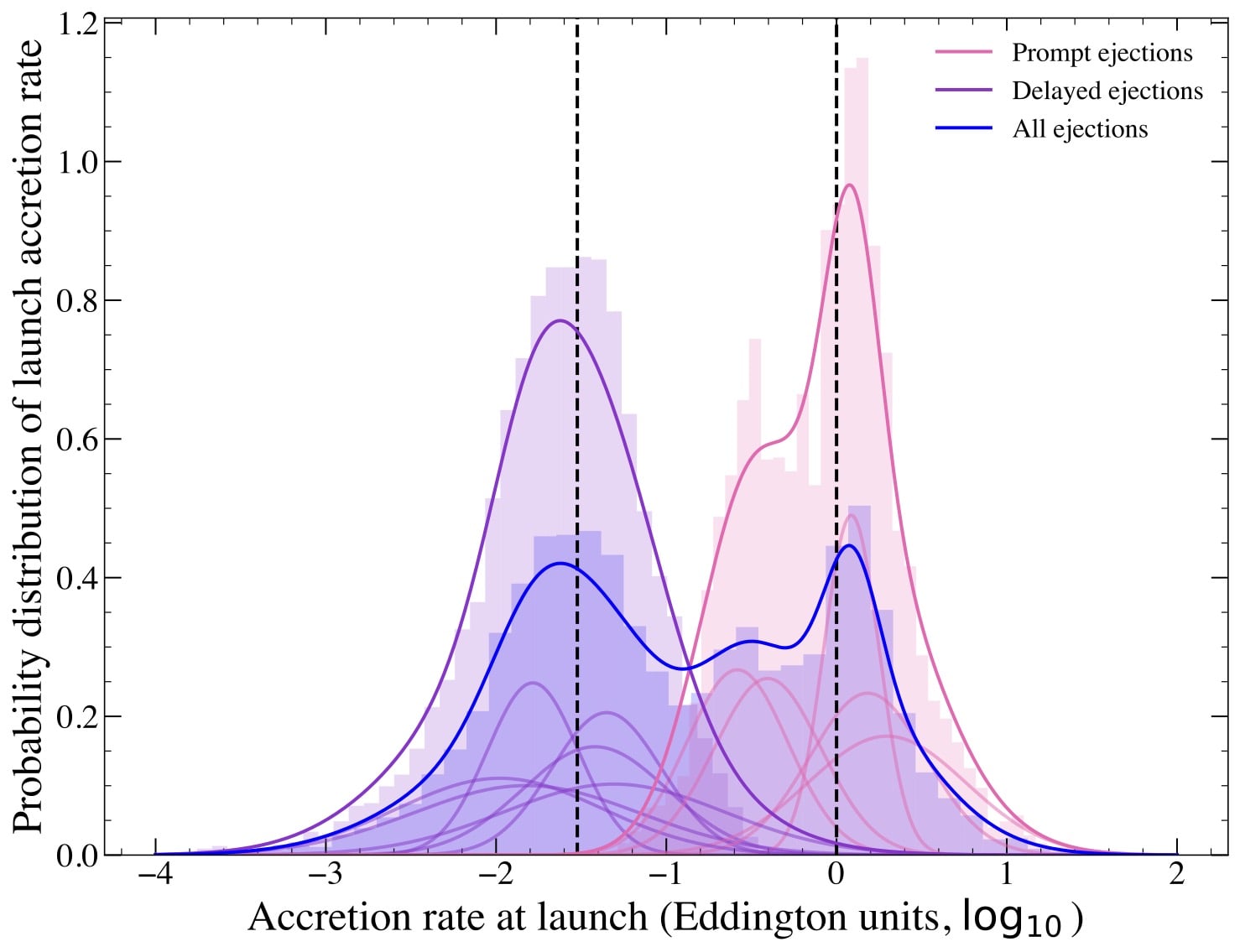
A comparison of primary and secondary jets. Credit: Goodwin, et al.
Supermassive black holes have a different eating method. They gather material by ripping apart stars that pass too closely. It’s known as a Tidal Disruption Event (TDE). This will allow the black hole to consume matter at a tremendous rate. Even faster than the Eddington limit. These TDEs can generate tremendous X-rays and quickly produce jets streaming from the black hole. Not all TDEs produce X-ray bursts for reasons we don’t entirely understand. Even more curious is the fact that some supermassive black holes without bright TDEs will also generate jets.
To understand this, the team focused on observations of twenty TDEs. They observed the events at radio, visible, ultraviolet, and X-ray frequencies. For about ten of these events, the team could determine both the rate of matter consumption and the formation of jets. They found that for bright TDEs there is a brief super-Eddington phase where the black holes rapidly consume matter and produce initial jets. After a few years these same black holes begin generating secondary jets. During this period, the black holes are consuming material from their accretion disks at about 2% of the Eddington Limit, just like stellar-mass black holes.
This means that for long-term jet formation, the process is scale invariant. Stellar-mass black holes and supermassive black holes both form accretion disks, and if they consume matter at a rate above the 2% level, then jets will form. What’s great about this result is that we can study the dynamics of stellar mass black holes to understand supermassive black holes.
Reference: Goodwin, Adelle J., and Andrew Mummery. “A universal critical accretion rate for black hole jet formation.” Nature Astronomy (2026): 1-13.